
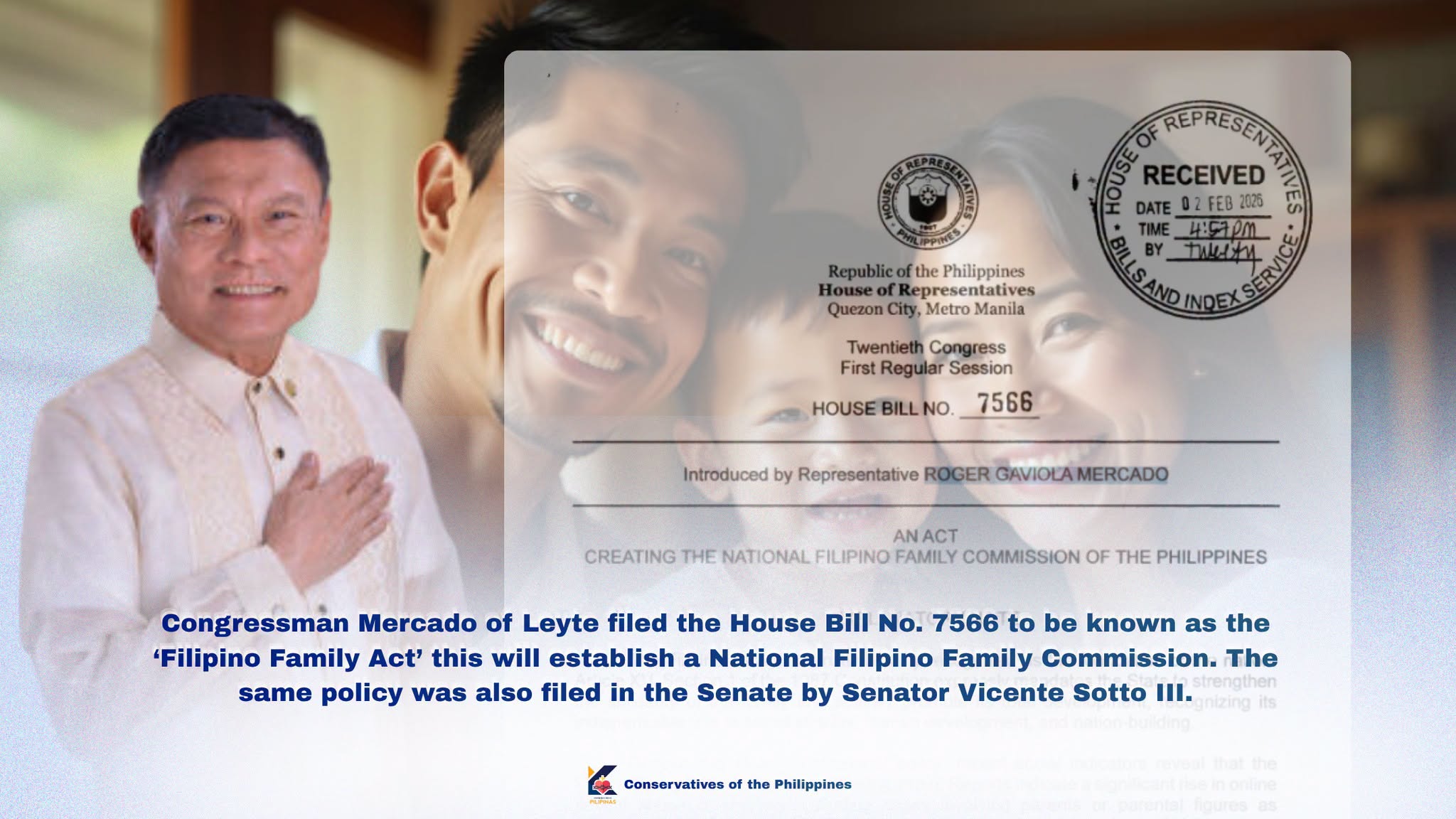
New Bill Proposes Filipino Family Commission to Combat Social Challenges
MANILA, Philippines — In response to growing societal pressures impacting Filipino households, Representative Roger Gaviola Mercado of the First District of Southern Leyte has filed House Bill No. 7566, titled the "Filipino Family Commission Act." Introduced during the Twentieth Congress, the proposed measure aims to establish a dedicated, proactive agency focused on strengthening, healing, and developing families before domestic breakdowns occur.
The bill cites alarming social trends across the country—including a rise in online sexual abuse of children, high numbers of births out of wedlock, a growing solo-parent population, and declining marriage and total fertility rates. Grounded in Article XV, Section 1 of the 1987 Philippine Constitution, the measure seeks to reinforce the family as an inviolable social institution by prioritizing active parental involvement and stable caregiving structures.
Under the proposed law, the Filipino Family Commission (FFC) will be established under the Office of the President. Serving as the primary policy formulation and data collation body on family welfare, the FFC will be led by a Commissioner and four Assistant Commissioners—each required to be members of the Integrated Bar of the Philippines with a strong background in family advocacy—serving a single six-year term. The FFC will also replace former advisory bodies by providing secretariat services to a newly created National Coordinating Council for the Filipino Family (NCCFF), composed of leaders across key cabinet departments and civil society groups.
Key functions of the FFC include building a national database on family issues, integrating pro-family life skills into school curricula, reviewing government budget allocations related to marriage and family welfare, and organizing annual national observances such as National Family Week and Family Thanksgiving Day.
To support these initiatives, the bill establishes a Family Development Fund designed to leverage public-private partnerships under Republic Act No. 11966, complete with tax incentives for private sector contributors. Furthermore, the legislation grants legal standing to parents, family associations, and taxpayers to seek judicial remedies—such as injunctions or writs of mandamus—to enforce compliance with the law. Initial funding will be drawn from current Department of Social Welfare and Development (DSWD) allocations before transitioning into the annual General Appropriations Act.